Beyond the Hype: What Quantum Mechanics Means for the Future of Computing
Another Wednesday talk kicked off in our inspiring space at Ship26, driven by our weekly goal of bringing fresh inspiration to our community. As we settled in, my co-founder Chris introduced our guest speaker: André Melo, a physicist specializing in computational quantum mechanics at Alice & Bob. André set out to demystify quantum physics and quantum computing, promising a journey through these complex topics without dropping a single differential equation on us.
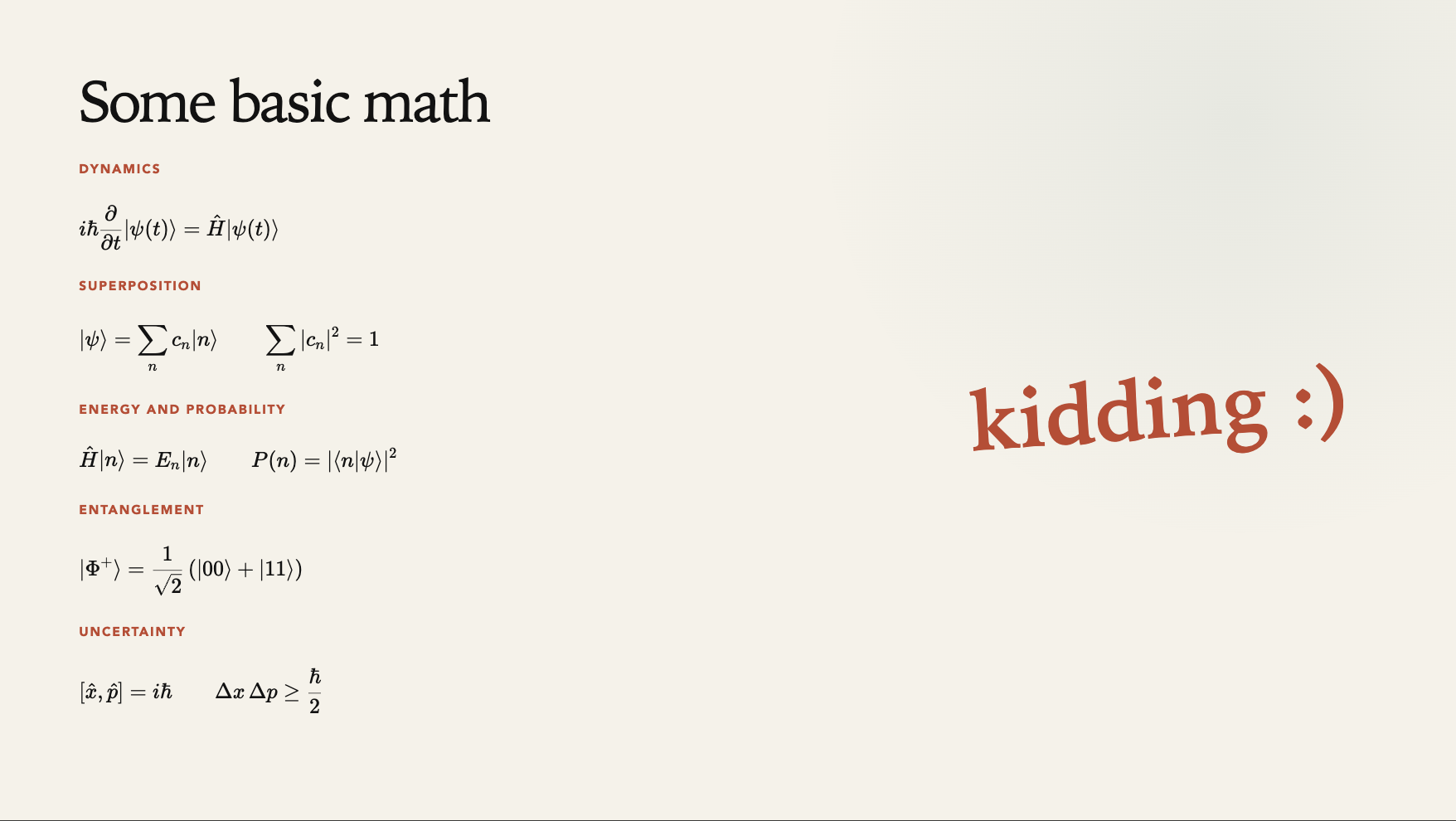
Usually, when I'm at a talk and don't understand something, my mind drifts off to surfing. My brain memory fills up, goes into chill mode, and the only thing left in my head is picturing top turns on a wave. That happened a few times during this talk, but I kept snapping back into André's world. How do I know this? The next day during our regular Ship26 run, my running partner Dominik asked me, "So, what did you actually learn from André?" At first, I paused, but as I started talking in between gasping for air, I realized André's talk had completely absorbed me. I had picked up a ton.
First, as I reflected, André shared a cool truth: everyone in the room had already used quantum mechanics that day. Smartphone screens, camera sensors, GPS atomic clocks, MRIs, and computer chips all rely on it.
Taking a phone screen as an example, he explained that the red, green, and blue light from subpixels isn't random. It relies on energy quantization, electrons get trapped in specific energy levels and emit precise colors of light only when they relax back down.
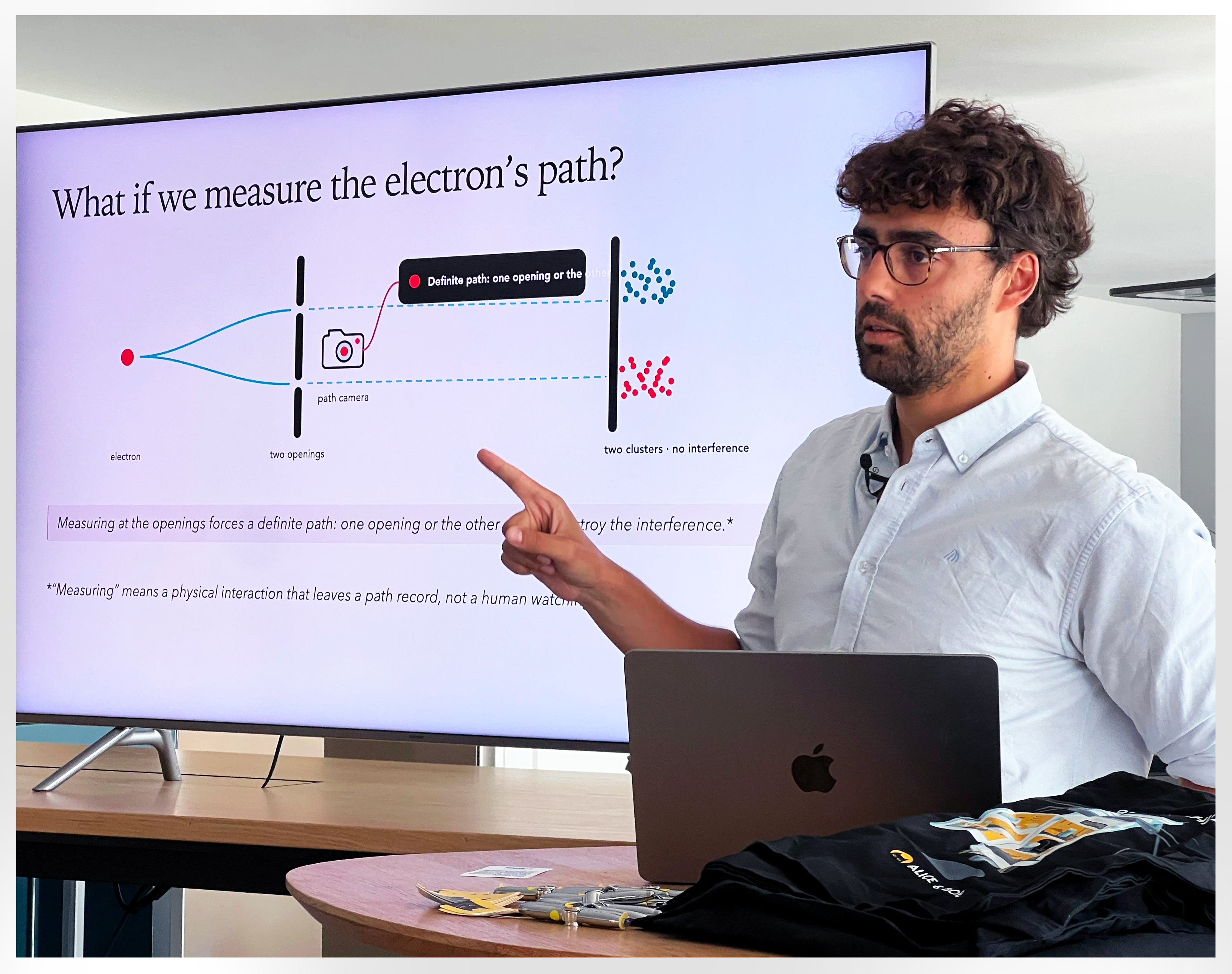
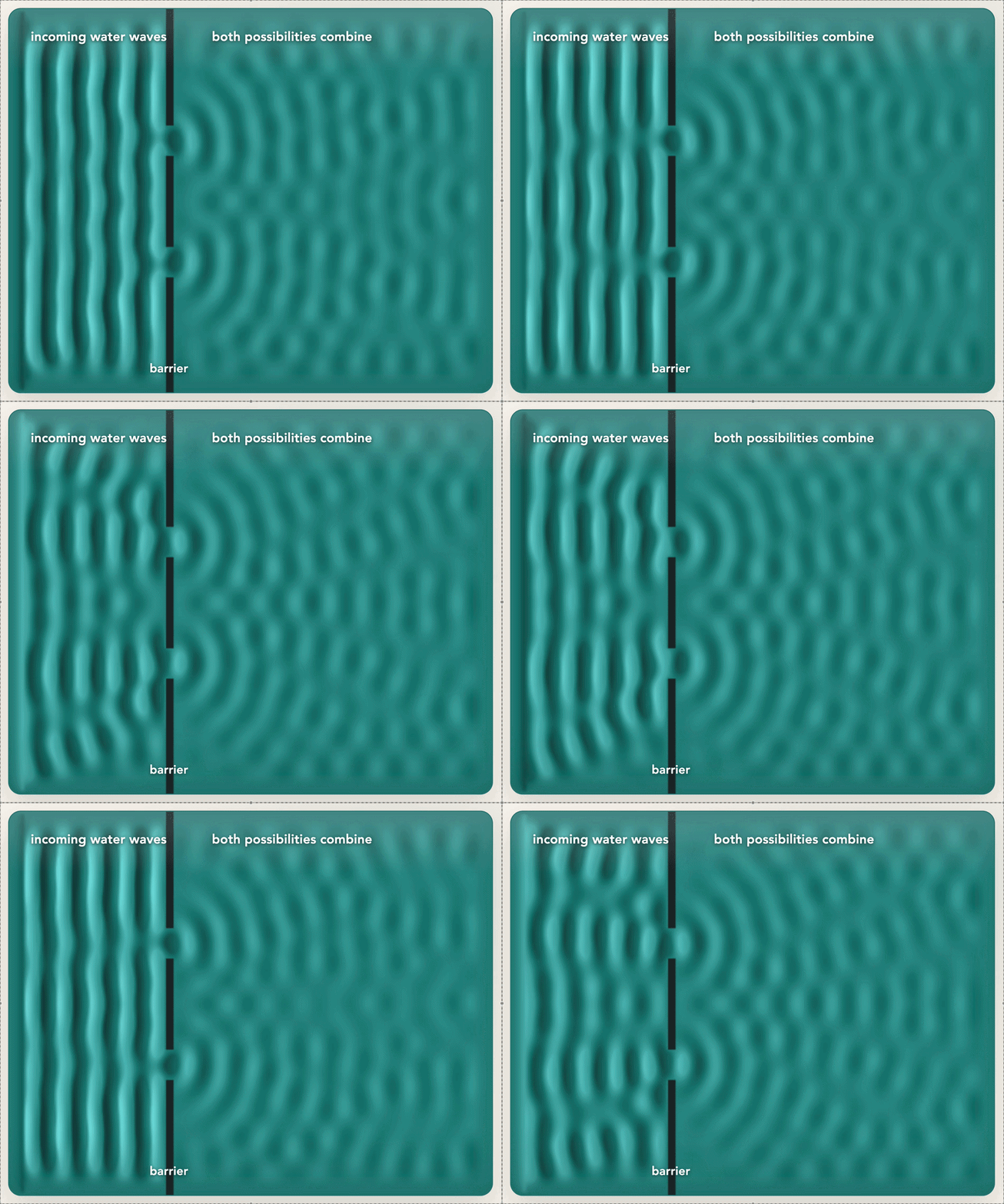
To show how weird quantum particles get, André brought up the classic double-slit experiment. When you shoot electrons through two narrow gaps, they don't act like tiny marbles choosing one side or the other. Instead, they travel like the waves, passing through both gaps at the exact same time and mingling with each other, a state called superposition. But here's the wild part: the second you try to observe which gap an electron goes through, it stops acting like a wave and snaps back into a normal particle. It's almost like quantum particles feel watched; when you look, they behave normally, but when you look away, they go back to their quantum tricks. (Like little children when the parents are there: fighting and being a real pain in the ass, but take the parents away and it's all good, pure harmony.)
To visualize a quantum bit (a qubit), think of normal computer bits like coins lying flat on a table, they are strictly Heads (1) or Tails (0). A qubit is like a coin spinning on its edge, existing as a blur of both Heads and Tails at the same time. When you link multiple qubits together, it's like having a whole table of spinning coins working in sync, creating a massive space of possibilities that gives quantum computers their power.
The biggest problem is a thing called decoherence. You see, qubits are insanely sensitive. If any tiny disturbance, like heat, light, or air, touches a spinning coin, it immediately falls flat. That interference acts as an accidental "measurement," breaking the quantum spell and forcing the qubit back into a regular 0 or 1. Keeping those coins spinning is the main challenge André is facing.
Another point is that quantum computers don't just "try every answer at once." No, they rather boost the correct answer while canceling out any wrong ones. This makes them specialized tools rather than replacements for everyday computers.
So, what are they actually good for? Because nature itself runs on quantum rules, quantum computers are a natural fit for simulating chemistry and physics. This opens the door to massive real-world breakthroughs, like designing life-saving drugs, super-efficient batteries, and futuristic materials.
André also highlighted some dude's algorithm (forgot his name, Shor's something, I think!), showing that a powerful quantum computer could crack the heavy math behind modern online encryption. Realizing a machine like that could break global data security is exactly what kicked off the global race to build one.
Today, around 500 companies are racing to build quantum hardware using totally different methods, ranging from super-chilled circuits colder than deep space to lasers trapping individual atoms. There was already some big milestones, like Google proving a quantum machine could solve a benchmark puzzle in 200 seconds that would take a standard supercomputer years to finish.

Still, André kept us grounded: everyday, commercially useful quantum computers are likely a decade away. Funding is flowing and the future looks bright, but getting there will take steady, step-by-step scientific work.
So after all, I did learn a lot from André, and in between, I got to ride André's quantum waves as well. Bargain!
Written by Xaver Walser, Co-Founder Ship26